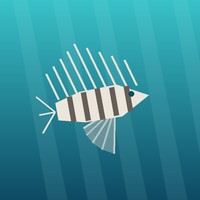
The lionfish invasion, and what culling actually does
Last updated 10 September 2026
Lionfish belong in the Indo-Pacific. They are now all over the western Atlantic, the Caribbean and the Gulf, where nothing eats them and they eat nearly everything. Divers spearing them is the main response anyone has. It works, locally, and it is worth being clear about what "locally" means.
Where they came from
Two closely related species — Pterois volitans and Pterois miles — are native to the Indo-Pacific and the Red Sea, where they are an ordinary part of a reef and are kept in check by the predators and parasites they evolved alongside. They were first reported off Florida in the mid-1980s, almost certainly released from home aquariums, and by the 2000s they were established along the US Southeast. From there they spread through the Bahamas, the wider Caribbean and the Gulf of Mexico.
It is one of the fastest marine invasions on record, and it was over before anyone had a plan for it.
Why they do so much damage
Three things compound.
- Nothing here eats them. Native Atlantic predators do not recognise a lionfish as food, and the venomous spines discourage the ones that try. The population has no top-down brake on it.
- They eat almost anything that fits. Lionfish are generalist ambush predators with a very large gape, and they take juvenile fish and crustaceans — including the young of species a reef depends on, and the young of species people fish for. A reef with lionfish on it recruits fewer native fish than the same reef without.
- They breed relentlessly. Females spawn year round rather than in a season, releasing tens of thousands of eggs every few days in a buoyant gelatinous mass that drifts on the current. That is how a local problem becomes a regional one.
The spines
A lionfish carries eighteen venomous spines — thirteen along the dorsal fin, two on the pelvics, three on the anal fin. The venom is a defence, not a hunting tool: a lionfish will not come at you. You get stung by putting a hand somewhere a spine already was, which is why the risk goes up precisely when you are handling a dead one.
A sting is intensely painful and occasionally causes a reaction that needs a hospital, but it is very rarely dangerous. The usual first aid is hot water, as hot as can be tolerated without scalding, which breaks down the venom. The meat is not venomous. Once the spines are off, a lionfish is a clean white fillet and a good one.
What culling does
Divers remove lionfish by hand, usually with a short pole spear or a Hawaiian sling and a puncture-proof containment tube, one fish at a time. There is no trap that catches lionfish and nothing else, no net that works on a reef, and no biological control anybody is willing to introduce after the last time.
Done consistently on a particular reef, it works. Sustained removals reduce lionfish density on that site, and the native fish that were being eaten come back. This is a real, measurable, repeatable result, and it is the reason organised derbies and volunteer cull programmes exist.
And the part that usually gets left out
Culling holds a reef. It does not clear the ocean, and it is not going to.
Lionfish live far deeper than any diver goes — down past a thousand feet — and those fish keep spawning into the same currents. Every cleared reef is being continuously re-seeded from water nobody can reach. Stop culling a site and it repopulates.
That is not an argument against doing it. It is an argument for understanding it correctly: this is maintenance, like weeding, not a war with an end. The reefs that stay in good shape are the ones somebody keeps going back to.
If you want to actually do this
These are the organisations doing the real work. We are not affiliated with any of them and none of them endorse us; they are listed because they are who you would go to.
- REEF — runs lionfish derbies, training and the long-running sighting database.
- Lionfish University — research funding and public education.
- The CORE Foundation — reef restoration and removal programmes.
- ECOMAR — Caribbean marine conservation and lionfish work.
- NOAA Fisheries — the US science on the invasion, and where most of the numbers above originate.
The other useful thing is the least heroic one: order it. Lionfish on a menu is demand, and demand is what pays a diver to keep going back to the same reef.
We made a game about this
Lionfish Hunter is a calm game about doing this job well: line up the shot, take it, bag the fish, move on, and watch the reef colour up behind you. It carries a short ecology sheet drawn from NOAA, including the paragraph above that a game would normally leave out.
Free, no in-app purchases · What the game is